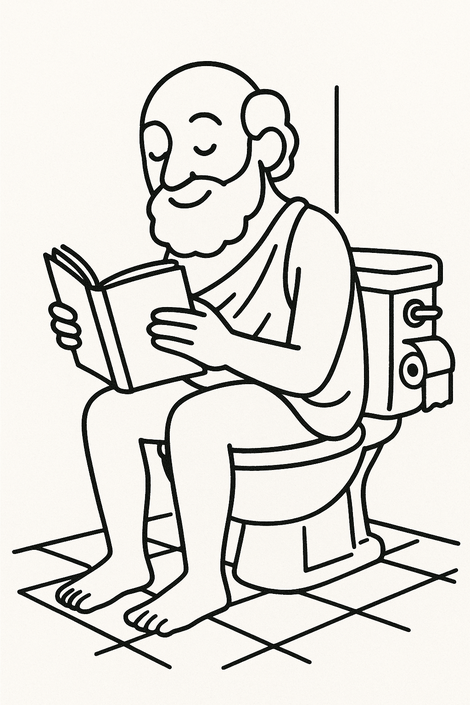
Ein Raum für experimentelles Denken an der Grenze der Sprache
Die Texte des Proemial Philosophie Blogs entziehen sich einem festen philosophischen Genre. Stattdessen verweben sie Dialog, Dichtung, Ironie und Reflexion zu einer Art postmoderner Gedankenpoesie. All das geschieht in einer Sprache, die zugleich verspielt und präzise ist, voll von Andeutungen, Parodien und Aporien. Der Blog ist keine systematische Philosophie – sondern eine Einladung, Philosophie als Spiel, als Klang, als Widerhall zu verstehen. Die Frage „Wozu?“ wird nicht beantwortet – sie wird transformiert. In Witz. In Geste. In Denken. Dennoch – oder gerade deshalb – lassen sich darin Spuren spezifischer philosophischer Denktraditionen ausmachen. Hier eine (unvollständige) Aufzählung.
1. Søren Kierkegaard – Die Paradoxie der Entscheidung
Kierkegaards Philosophie ist geprägt von der Spannung zwischen Freiheit und Angst, zwischen Entscheidung und Nicht-Wissen. Diese Spannung durchzieht auch die Proemial-Texte in ironischer Brechung. Hier wird nicht entschieden – nicht aus Schwäche, sondern aus bewusster Weigerung, sich dem Zwang der Alternativen zu unterwerfen. Dies ist ein typischer existenzialistischer Topos: Der Mensch steht in der Verantwortung, frei zu wählen, aber er kann sich dieser Freiheit auch verweigern – was paradoxerweise selbst wieder eine Wahl darstellt.
2. Friedrich Nietzsche – Der Sinn als schöpferische Illusion
Besonders stark ist Nietzsche dort spürbar, wo Begriffe wie „Sinn“, „Wert“ oder „Ziel“ ironisch gebrochen, aber nicht zynisch verworfen werden. Die Welt ist absurd, ja, aber gerade deshalb kann der Mensch zum „Sinngeber“ werden. Nietzsche erscheint im Blog nicht durch direkte Zitate, sondern durch einen thematischen Grundton: Sinn wird nicht gefunden, sondern konstruiert. Die Sinnfrage wird karikiert – der Gedanke, dass das Universum selbstständig auf Sinn hindeutet, wird ad absurdum geführt. Gleichzeitig wird aber auch betont, dass man sich durchaus „für einen Sinn entscheiden“ könne – ganz im Geiste von Nietzsches „Umwertung aller Werte“, bei der nicht das Finden von Wahrheit, sondern die Schaffung von Bedeutung im Zentrum steht.
3. Adorno – Denken ohne Lösung, Kritik ohne System
Adornos Negative Dialektik steht hier Pate: Der Versuch, durch Denken nicht zu versöhnen, sondern das Unversöhnte sichtbar zu machen, ohne es in einer falschen Synthese zu überdecken. In der oft tastenden, assoziativen und gegenkategorialen Sprache vieler Texte klingt der Einfluss Theodor W. Adornos an. Nicht die endgültige Erklärung steht im Zentrum, sondern das Offenhalten des Gedankens, das Umkreisen eines Problems ohne es abzuschließen. Die Texte spielen mit der Sprache so, wie Adorno mit Begriffen spielte – um das Unabgeschlossene zu zeigen, das sich jeder Systematik entzieht.
4. Heidegger – Welt, Sein und der „Klang der Frage“
Einige Texte führen – in fast heideggerianischem Duktus – Fragen, wie sie im frühen Sein und Zeit aufgeworfen werden, performativ vor. Das „In-der-Welt-Sein“ als Frage, das Dasein als Suchender, das Seiende als Fragment: All das wird hier weniger analysiert als durch Sprache evoziert. Die Frage „Warum muss man denn überhaupt etwas tun?“ evoziert Heideggers Konzept der Geworfenheit, während eine beinahe existentielle Gelassenheit formuliert wird, wie sie Heidegger im späten Werk zur Sprache bringt (Gelassenheit).
5. Metzinger, Dennett & die Neurophilosophie – Das Ich als Illusion
Es werden neurowissenschaftliche Positionen aufgenommen. Die Rede vom Ich als „Emanation“ und das Gehirn als „komplizierte Rechenmaschine“ spiegeln Positionen wider, wie sie bei Thomas Metzinger oder Daniel Dennett zu finden sind. Das Ich wird nicht als Substanz, sondern als emergentes Phänomen behandelt, das unter bestimmten Bedingungen auftritt und wieder verschwindet. Gleichzeitig wird diese Vorstellung auch kritisch und ironisch unterlaufen. So wird sichtbar: Die Texte verhandeln das Ich nicht als metaphysische Konstante, sondern als Konstruktion – wobei sie diese Konstruktion selbst wieder zur Disposition stellen.
6. Wittgenstein & die Sprachkritik
Viele Dialoge wirken wie Hommagen an Wittgensteins Spätwerk, insbesondere die Philosophischen Untersuchungen. Die absurde, fast dadaistische Sprache erinnert an die Grenzen sprachlicher Bedeutung: Poetische Anspielungen auf das Zeigen, nicht das Sagen. Die Sprache will nicht erklären, sondern Hinweise geben. Das ist zutiefst wittgensteinianisch: „Wovon man nicht sprechen kann, darüber muss man schweigen.“
7. Poststrukturalisten & Ironiker: Derrida, Sloterdijk, Pfaller
Der Stil des Blogs spielt ständig mit Dekonstruktion, Ironie und Sprachwitz. Parodien der Sprachform selbst – bedeutungsleer und dennoch strukturiert, wie dekonstruktive „Textleiber“. Hier wird die Bedeutung performativ unterlaufen, wie es bei Derrida üblich ist: Der Text verweist auf nichts außerhalb seiner selbst – ein Spiel mit der Erwartung des Sinns, das ihn zugleich verspottet.
Ebenso Sloterdijk: Es wird über evolutive Ironien sinniert, Sloterdijks anthropotechnischer Zynismus klingt durch – der Mensch als Übergangsphänomen, als ironische Erfindung der Evolution.
Der Autor
Der Autor von Proemial bleibt bewusst anonym. Die Beiträge sind oft dialogisch gestaltet, mit wiederkehrenden Namen wie „Helmut“ und „Winfried“, die jedoch eher als stilistisches Mittel denn als reale Personen zu verstehen sind. Diese Anonymität scheint Teil des Konzepts zu sein, das sich auf philosophische Inhalte konzentriert, ohne durch persönliche Autorenschaft beeinflusst zu werden.
A Space for Experimental Thought at the Edge of Language
The texts of the Proemial Philosophy Blog elude classification within any fixed philosophical genre. Instead, they weave together dialogue, poetry, irony, and reflection into a kind of postmodern thought-poetry. All of this unfolds in a language that is both playful and precise, full of allusions, parodies, and aporias. The blog is not systematic philosophy — it is an invitation to understand philosophy as play, as resonance, as echo. The question “What for?” is not answered — it is transformed. Into wit. Into gesture. Into thought. Nevertheless — or precisely because of this — traces of specific philosophical traditions can be discerned within it. Here is an (incomplete) list.
1. Søren Kierkegaard – The Paradox of Decision
Kierkegaard's philosophy is shaped by the tension between freedom and anxiety, between decision and not-knowing. This tension also runs through the Proemial texts in an ironically twisted form. Decisions are not made — not out of weakness, but from a deliberate refusal to submit to the compulsion of alternatives. This is a typical existentialist motif: the human being is responsible for choosing freely, but can also refuse this freedom — which, paradoxically, is itself a choice.
2. Friedrich Nietzsche – Meaning as Creative Illusion
Nietzsche is especially present where terms like “meaning”, “value”, or “goal” are ironically subverted, but not cynically dismissed. The world is absurd, yes — but precisely for that reason, the human being becomes a creator of meaning. Nietzsche appears in the blog not through direct quotations but through a thematic undertone: meaning is not discovered but constructed. The question of meaning is caricatured — the idea that the universe points toward meaning on its own is pushed to absurdity. At the same time, it is emphasized that one can, indeed, choose a meaning — very much in the spirit of Nietzsche’s revaluation of all values, in which the creation of significance takes precedence over the discovery of truth.
3. Adorno – Thinking Without Solution, Critique Without System
Adorno’s Negative Dialectics is an underlying force here: the attempt to make the non-reconciled visible through thought — without falsely reconciling it in synthesis. In the often tentative, associative, and anti-categorical language of many texts, the influence of Theodor W. Adorno is palpable. The point is not a final explanation, but keeping the thought open, circling around a problem without resolving it. The texts play with language just as Adorno played with concepts — to reveal the unfinished, which evades all systematization.
4. Heidegger – World, Being, and the “Tone of the Question”
Some texts — in almost Heideggerian diction — enact questions as posed in the early Being and Time. Being-in-the-world as a question, Dasein as a seeker, Being as fragment: all of this is not so much analyzed as evoked through language. The question “Why does one have to do anything at all?” evokes Heidegger’s concept of thrownness, while a kind of existential serenity is articulated — akin to the idea of Gelassenheit from his later work.
5. Metzinger, Dennett & Neurophilosophy – The Self as Illusion
Neuroscientific positions are incorporated. The reference to the self as “emanation” and the brain as a “complex calculating machine” reflects ideas found in thinkers like Thomas Metzinger or Daniel Dennett. The self is not treated as a substance, but as an emergent phenomenon that appears under certain conditions — and disappears under others. At the same time, this notion is also treated critically and ironically. It becomes clear: the texts treat the self not as a metaphysical constant but as a construction — while simultaneously placing this construction itself into question.
6. Wittgenstein & the Critique of Language
Many dialogues read like homages to Wittgenstein’s later work, especially the Philosophical Investigations. The absurd, almost Dadaist language recalls the limits of linguistic meaning: poetic gestures toward showing, not saying. Language is not meant to explain, but to hint. This is deeply Wittgensteinian: “Whereof one cannot speak, thereof one must be silent.”
7. Poststructuralists & Ironists: Derrida, Sloterdijk, Pfaller
The blog’s style constantly plays with deconstruction, irony, and linguistic wit. Parodies of language forms themselves — devoid of meaning and yet structured, like deconstructive “text bodies.” Here, meaning is performatively undermined, as with Derrida: the text refers to nothing outside itself — a play on the expectation of meaning, while simultaneously mocking it.
Likewise with Sloterdijk: reflections on evolutionary ironies recall Sloterdijk’s anthropotechnical cynicism — the human as a transitional phenomenon, an ironic invention of evolution.
The Author
The author of Proemial maintains a deliberate anonymity, with no publicly available information revealing their identity. The blog's content demonstrates a deep engagement with philosophical topics, suggesting that the author possesses substantial knowledge in the field. The anonymity appears to be a conscious choice, potentially aimed at focusing readers' attention solely on the philosophical discussions presented.